EMT Practice Test

1. Question Content...


Question List

Question1: Which three statements are true of calculation contexts?
There are 3 correct answers to this question.
Response:

Question2: How many blocks can you create in a Web Intelligence document (WID)?
Please choose the correct answer.
Response:

Question3: Why purge data in a document before saving to the BI platform? Note: There are 2 correct Answers to this question.

Question4: What option do you select to change the Total Revenue to a currency (shown in the attached graphic)?

Question5: Which two break properties can you use when setting Break Priority?
There are 2 correct answers to this question.
Response:

Question6: Which three output context expressions are valid extended syntax expressions?
There are 3 correct answers to this question.
Response:

Question7: How can you make the pie chart (shown in the attached graphic) display correctly?

Question8: Which of the following sequence is correct -To Insert a Block in Each Section?
Please choose the correct answer.
Response:

Question9: What is required to use the Comments feature? Note: There are 2 correct Answers to this question.

Question10: Why do you use the "Turn into" functionality?

Question11: Elucidate the advantages of saving formulas as variables?
Please choose the correct answer.
Response:

Question12: Which statement is true about calculation contexts?
Please choose the correct answer.
Response:

Question13: Which of these actions clear the stored data when tracking data changes? Note: There are 3 correct Answers to this question.

Question14: Discuss all the advantages link to organizing a report in the section
There are 2 correct answers to this question
Response:

Question15: Which two statements are true of contexts?
There are 2 correct answers to this question.
Response:

Question16: In the query panel, you modify the script and no errors occur. You remove an object and add a different object to the Results Object pane. What happens to the script?

Question17: Which of the following can you use to filter results dynamically? Note: There are 2 correct Answers to this question.

Question18: Which scenarios should you use breaks for?
There are 2 correct answers to this question.
Response:

Question19: Which method should you use to view alerts in a report?
Please choose the correct answer.
Response:

Question20: Mention the five types of column charts for presenting DATA?
There are 3 correct answers to this question
Response:

Question21: Which report elements can you drill on? Note: There are 3 correct Answers to this question.

Question22: Which three can you use to start the Web Intelligence Rich Client from?
There are 3 correct answers to this question.
Response:

Question23: What are the benefits of using SAP Business Objects Web Intelligence? (2 correct answers)

Question24: In which of the following can you use the If( ) function in Web Intelligence?

Question25: The universe is made up of classes and objects; there are three different types of objects. What are they?
There are 3 correct answers to this question
Response:

Question26: Which two options are valid options when you save a Web Intelligence document (WID) in the Web Intelligence Rich Client?
There are 2 correct answers to this question.
Response:

Question27: Why is the subtotal missing from the bottom of each break in the attached diagram?

Question28: Which sort option should you use to add Temporary Values?
Please choose the correct answer.
Response:

Question29: How does SAP recommend you print a Web Intelligence document to ensure that the document layout is preserved?

Question30: Which operators can be used in an Input calculation context?
There are 2 correct answers to this question.
Response:

Question31: What tasks can you perform in the data application mode? Note: There are 2 correct Answers to this question.

Question32: Which three types of local data files can you use to create a BusinessObjects Web Intelligence 4.0 document (WID)?
There are 3 correct answers to this question.
Response:

Question33: How does the WHERE operator affect a formula?

Question34: What does the Change Source Wizard use to remap existing objects to a new data source? (2 answers)

Question35: In which of the following can you use If ( ) function in Web Intelligence?

Question36: To produce a report that focuses more precisely on certain data, you may need to apply more than one filter, and these filter must use Logical Operators.
What are these Logical operators?
There are 2 correct answers to this question
Response:

Question37: Which data sources can you access directly using Web Intelligence?

Question38: Conditional formatting rules enable you to highlight results that meet or fail specific business targets. Name the elements associated with the Formatting rules?
There are 3 correct answers to this question
Response:

Question39: Which of the following query types can you use for combined queries? Note: There are 3 correct Answers to this question.

Question40: Which of the following is not a step of demonstration, to display an aggregate within a sectioned report.
Please choose the correct answer.
Response:

Question41: What object type is found in navigation paths?

Question42: Which two statements are true about using the Where operator with an output context?
There are 2 correct answers to this question.
Response:

Question43: From the following identify which of the option is not a method to copy a chart from Web Intelligence to a target application?
Please choose the correct answer.
Response:

Question44: Which two statements are correct about saving documents?
There are 2 correct answers to this question.
Response:

Question45: Which statement is true of an output context operator?
Please choose the correct answer.
Response:

Question46: You are creating a report to summarize the number of cars sold by region. Which object should you use to aggregate the number of cars sold?
Please choose the correct answer.
Response:

Question47: Which of the following are extended syntax keywords? (2 answers)

Question48: Which reporting tool should you use to create a Web Intelligence document (WID) directly from an Excel data source?
Please choose the correct answer.
Response:

Question49: What is the required argument of the UserResponse( ) function?

Question50: Where do you view merged dimensions?
Please choose the correct answer.
Response:

Question51: How do you access the Format Table option?

Question52: How do you determine if a formula or a variable is used in a block? Note: There are 2 correct Answers to this question.

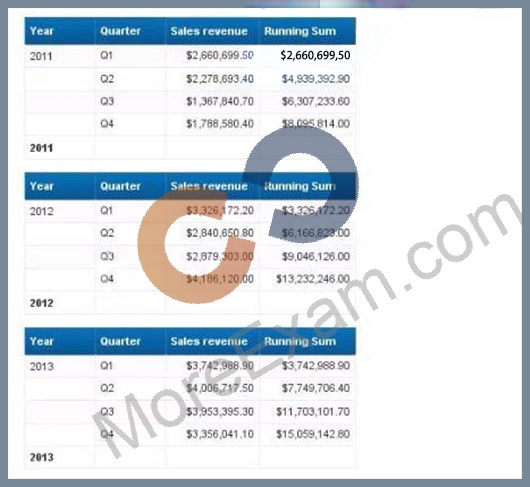
Question53: What is the correct formula for the RunningSum column (shown in the attached graphic)?
Question54: Which of the following can you use to filter results dynamically? (2 answers)

Question55: What is the purpose of Demonstration: To Create a Simple Web Intelligence Document?
Please choose the correct answer.
Response:

Question56: You are asked to create a table to display revenue data values in three distinct colors. What must you create in a single conditional formatting rule?

Question57: For which tasks do you use an If() function?
There are 2 correct answers to this question.
Response:

Question58: You want to compare the sales revenue performance of the top 20% of your customers to the average of all of your customers.
You decide to apply a rank on the table that shows customers and revenue and create a variable to show the average revenue for all customers.
Which function should you use in the variable?
Response:

Question59: What items can be presented in a free-standing cell? (2 answers)

Question60: How does rearranging the objects in the Result pane after the query has run affect the block display?
Please choose the correct answer.
Response:

Question61: Which two are running aggregate functions in Web Intelligence?
There are 2 correct answers to this question.
Response:

Question62: What is a Web Intelligence variable?

Question63: Which three statements are true about alerters?
There are 3 correct answers to this question.
Response:

Question64: Which two statements are true about the AND operator?
There are 2 correct answers to this question.
Response:

Question65: A table contains a dimension [CITY] and a measure [SALES]. You insert a column to display the formula AVERAGE([SALES]). Which operator do you add to the formula so that it displays the average for the table in every row? Note: There are 2 correct Answers to this question.

Question66: To what can you apply a conditional formatting rule? Note: There are 2 correct Answers to this question.

Question67: What data sources can you select when creating a document using the Web Intelligence Rich Client?
Note: There are 2 correct Answers to this question.

Question68: Which two properties can you set in the hyperlink dialog box when you create a hyperlink to a document?
There are 2 correct answers to this question.
Response:

Question69: You add a new object to a query and run the query. How do you display the new object in the document?

Question70: Which tool do you use to edit merged objects in BusinessObjects Web Intelligence 4.0?
Please choose the correct answer.
Response:

Question71: Where can you use a free-standing cell?

Question72: Which of the following options involved to Create Variable from the Formula?
There are 2 correct answers to this question
Response:

Question73: Which three methods can you use to combine queries using the Web Intelligence Rich Client?
There are 3 correct answers to this question.
Response:

Question74: When using the ranking feature on a table, which expression allows you to display the total of all values (both ranked and unranked) in the footer of the block?

Question75: Which methods can you use to apply report filters to a BusinessObjects Web Intelligence XI 4.x document (WID)?
There are 2 correct answers to this question.
Response:

Question76: You need to create a report that compares data to a reference data set. You create the report and activate the track data option. The report correctly indicates the changes in the data; however when you make another change to the report, the display no longer indicates any data tracking.
What actions could have caused this behavior?
There are 2 correct answers to this question.
Response:

Question77: How can you make the pie chart (shown in the attached graphic) display correctly?

Question78: Which two data sources can you directly access from a Web Intelligence document (WID) using the Web Intelligence Rich Client?
There are 2 correct answers to this question.
Response:

Question79: Which keyword is defined as flexible for input contexts?
Please choose the correct answer.
Response:

Question80: Where can you set the priority options for saving a Web Intelligence document (WID) to Microsoft Excel?
Please choose the correct answer.
Response:

Question81: In the query panel, you modify the script and no errors occur. You remove an object and add a different object to the Result Object pane. What happens to the script?

Question82: When scheduling Web Intelligence document, what output formats are available? (2 answers)

Question83: Which two options should you take before you finish creating a variable in Web Intelligence?
There are 2 correct answers to this question.
Response:

Question84: Which two are benefits of creating queries from existing queries?
There are 2 correct answers to this question.
Response:

Question85: Identify from the given options the correct sequence of 'Web Intelligence Core Functions'?
Please choose the correct answer.
Response:

Question86: How does WHERE operator affect a formula?

Question87: To what can you apply conditional formatting rules? (2 answers)

Question88: Which is a benefit of using query drill?
Please choose the correct answer.
Response:

Question89: Which three calculations can you use in a measure object in Web Intelligence?
There are 3 correct answers to this question.
Response:

Question90: What are the terms you need to be familiar with to understand how semantic layer functions for relational databases?
There are 3 correct answers to this question
Response:

Question91: Which two Web Intelligence Rich Client authentication methods enable you to export Web Intelligence documents (WID) to the Central Management Server (CMS)?
There are 2 correct answers to this question.
Response:

Question92: You insert the function CurrentDate() into a cell. To clarify the date you add a string so that the formula is now:
="Sales Report from "+CurrentDate()
Which formatting capability is disabled for the cell?
Please choose the correct answer.
Response:

Question93: Which Web Intelligence component should you use to list the existing variables in a report?
Please choose the correct answer.
Response:

Question94: How do you share a Web Intelligence document with another user in the BI launch pad? Note: There are
2 correct Answers to this question.

Question95: Your data source has the following values: SMITH, SMYTH, SMALL, SMOOTH, SMART, SMILEY. What syntax do you use to show only the names SMITH and SMYTH?

Question96: How do you make changes to a document that has been published in the BI launch pad? Note: There are
2 correct Answers to this question.

Question97: Which statement describes the performance impact that data tracking has on report refresh times, assuming that the data changes but the number of rows retrieved and the data volume stays the same?
Please choose the correct answer.
Response:

Question98: What is the default behavior when creating a report from two queries from the same universe?
Please choose the correct answer.
Response:

Question99: What operator do you select to use a wildcard character in a Web Intelligence query?

Question100: In the Web Intelligence Desktop, when you save a document as an Excel file, you can specify which reports saving; Following are the options available to save and export data?
There are 2 correct answers to this question
Response:

Question101: Which character should you use to reset the result of the RunningSum( ) function for either a break or a section?
Please choose the correct answer.
Response:

Question102: What can you use breaks for?
Please choose the correct answer.
Response: